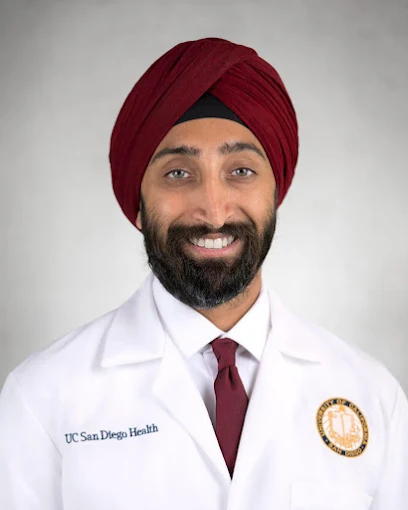
Dr. Dennis Morozov
Anesthesiology resident (CA-1, PGY-2) at UC San Diego. East Coast native who grew up in a family of physicians before moving west for residency training.
The conversation.
When I sat down with Dr. Dennis Morozov, one thing became clear almost immediately — he genuinely enjoys what he does. Dr. Morozov is an anesthesiology resident at UC San Diego who grew up on the East Coast before making the move to California for residency. Coming from a family of physicians, medicine was always part of his life, but he explained that it wasn't something he simply fell into because of his family. It was during college, after spending more time around patients and healthcare, that he realized he wanted a career where he could combine science with working directly with people.
Throughout our conversation, he gave an honest look into medical school, residency, what anesthesiologists actually do, and the advice he wishes someone had given him when he was younger.
What stayed with me.
Find the Right Reasons to Pursue Medicine
One of my favorite parts of the interview was hearing that Dr. Morozov didn't have everything figured out from the beginning. Even though several members of his family were physicians, he still took time to explore different interests before realizing medicine was the right fit.
He talked about how what ultimately drew him in wasn't just the science — it was the opportunity to help people while constantly learning. His story was a good reminder that you don't have to know exactly what specialty, or even what career, you want at a young age. It's okay for your interests to develop over time.
Medical School Isn't About Studying Every Minute
A lot of students imagine medical school as four years of nonstop studying with no personal life. Dr. Morozov admitted he had that same fear before starting.
In reality, he said today's medical schools give students much more flexibility than people often realize. While the workload is still demanding, staying organized and managing your time well makes it possible to do well academically while still having a life outside the classroom.
He also shared something I hadn't really considered before: because many medical school exams have moved to pass/fail, residency programs are placing much more emphasis on clinical performance, research, leadership, and the evaluations students receive from physicians during their rotations.
Anesthesiology Is Much More Than "Putting People to Sleep"
Before this interview, I knew anesthesiologists played an important role in surgery, but I didn't realize just how much responsibility they have.
Dr. Morozov walked me through a typical day, which often starts before 5:30 in the morning. Long before a patient enters the operating room, the anesthesia team is reviewing medical records, preparing medications and equipment, and developing a plan that's tailored to each individual patient.
During surgery, anesthesiologists are constantly balancing multiple priorities at once — keeping the patient unconscious, controlling pain, managing breathing and blood pressure, and making sure the patient remains safe from beginning to end. Listening to him describe everything happening behind the scenes gave me an entirely new appreciation for the specialty.
Build Good Habits Before You Build a Resume
I expected Dr. Morozov to tell high school students to spend every summer shadowing doctors or trying to pack their resumes with activities.
Instead, his advice was surprisingly simple.
He encouraged students to enjoy high school while they're still in it. Shadowing and volunteering can absolutely be valuable, but he believes the most important thing students can do is build habits they'll rely on later — staying organized, keeping up with school, challenging themselves academically, and maintaining a healthy lifestyle.
Those habits, he said, end up being much more valuable than trying to check every possible box as early as possible.
What we talked about.
- 01The path from Maryland to San Diego
- 02What med school is actually like now
- 03A day inside the OR
- 04Why UCSD's culture matters
- 05Advice to high schoolers
Watch the full conversation with Dr. Dennis Morozov.
The conversation, in full.
Can you introduce yourself, and can you just tell me a little bit about your journey into medicine?
Sure, thanks for having me and talking with me. My name is Dennis. I am an anesthesia resident at UCSD, University of California, San Diego, and I am initially from the East Coast but have kind of migrated over here to the West to do my training. And about me personally, I come from an immigrant family. I do come from kind of somewhat of a family background of doctors, and I did most of my undergrad and medical school in Maryland, the University of Maryland, which is where I grew up, and then, as I mentioned, came over here to continue my residency training in anesthesia at the University of California, San Diego. So that's kind of my big picture life.
When would you say medicine first became something you considered, and was there any sort of specific experience that influenced that?
Yeah. I think, funny enough, I think being around physicians. So my dad is a doctor. My grandparents were doctors. My mom's side of the family has some physicians as well, but my mom is not. But I think being around doctors a lot kind of puts that job in your mind more easily, or more readily, than any job that your parents or family members would do would, and so I think growing up, it was always kind of in the back of my mind that it would be a possibility. I definitely went through like a bunch of different phases of life figuring out other things. And it wasn't really until I think college, and when I started doing kind of some more exposure with the medicine side of things. I was definitely like a science and math guy for sure. So once I kind of figured that out and then went to college and I got more exposure, that's when I really kind of solidified my interest in the kind of patient-facing side of scientific care that you don't really get with a lot of other scientific fields, and so I really thought it was cool to be that kind of person who could be taking care of someone, practicing science as in medicine, right, and then also kind of being a leader in that scientific role, which is very unique to physicians as well in the broad science world.
What is one thing you wish you knew before starting med school?
That's a really good question actually. I think there's a big fear for a lot of people that med school is going to be really consuming, and I think that was definitely a source of a little bit of anxiety for me as well before I started med school. I think what most medical schools are doing now is figuring out a really good way to put the learning into the learner's hands and then giving them the tools to kind of, after you have your background science stuff learned, give you the tools to kind of learn at your own pace in your own way. And I think that creates a really good balance if you're able to tolerate it, with your life. And so it makes med school not as consuming as maybe it was in the past. And it's still very difficult, but if you can stay organized and stay on top of your studies, it becomes easier. And it's still time-consuming, but if you can balance your time well with the way med school is now structured, you really can live a normal-ish 20-year-old life.
In your personal experience from what you've seen from yourself and your peers around you, what do you think separates a student who matches into a competitive specialty such as anesthesiology from those who struggle?
Yeah, so this is kind of just figuring out what your interests are first. That would be the first step, because you know, not all specialties are as competitive. They're all very important in their own ways. But just based on, like, the number of available residency spots, that's really the only reason that they become competitive. I think that once you figure out that, hey, I am interested in a competitive specialty, which is probably closer to your second or third year of med school, once you've kind of started exploring some areas, you have to start thinking about what is gonna look good on your resume, which is your residency application, because certain things are gonna make you stand out. Funny enough, a lot of, for better or for worse, a lot of standardized tests in medical school are moving away from a scored scale and are moving to pass/fail, which can be good from a mental health standpoint when you're first taking the exam, but also can kind of hurt you later on if you are someone who studied really hard and wanted a good score, and that's not something that you can use anymore to make yourself stand out. And so what that means is that a lot of residency programs, the competitive ones, are looking at other things now besides just your scores. They're looking at how well you did during your clinical rotations, which happen during third year. They're specifically not only looking at how well you do there, but they're looking at the comments that go in your application, the comments from your preceptors and your attendings that you work with. Those get sent to the residency program. They're also looking for other things. A lot of programs now are looking for research as well. And when you're in med school, you're gonna be inundated with research opportunities, so they're not hard to get. It's just about balancing your time, which is what I talked about earlier. And then they're looking at kind of leadership roles too because a lot of competitive specialties do have leadership requirements in their field, and they wanna see that they're taking someone who can step up into a leadership role if needed. Small caveat about leadership roles in med school, and this kind of goes back to research as well. It's less important to have a leadership role than it is to do well on your rotations. So if you're someone who needs a lot more time to make sure they actually succeed in medical school and succeed on their rotations and are not sure that they could pick up leadership roles, that needs to go by the wayside, and you need to focus on your studies. If you can balance both, then that's a different story, and that's something that is kind of looked upon with a little bit more regard because when you are in those competitive structures, you're gonna have to find a way to balance a lot of your limited time.
Could you walk me through what a typical day looks like for you?
Yeah. Sure. So, you know, funny enough, I'm really just getting started doing hands-on anesthesia, so I'll tell you what my day looks like right now. It will look different when I'm an attending, but from a resident standpoint, this might be kind of explaining, like, the role of anesthesiologists as well. So I think we can take a step back and talk about that first just because it'll be hard for me to explain what I do if someone doesn't really know what we do in the first place. So anesthesia providers, they take care of the patient in the pre-op, which is pre-operatively, the intra-operatively, so during the surgery, and then post-operatively. So those are the three phases of care that anesthesia providers are kind of responsible for. And so my day-to-day looks like making sure seeing the patient in the preoperative bay. So that means I need to get to the hospital very early because surgeries start at like 7:00 AM most days, around there. And so I need to get to the hospital around like 5:15, 5:30 most days, and I need to see the patient by 6:00 because we also have morning conference where all the anesthesiologists get together and do learning topics or talk about a case. So that requires me to get to the hospital very early because I need to set up the operating room the way I need it for the specific case, and then I need to go see the patient and make sure nothing has changed. I need to go through the patient's record. I need to figure out what their past medical history is, what comorbidities they have, how that's gonna change my anesthetic plan, and I would go to conference. I would come back. By that point, the OR room from the surgical side is also set up. You bring the patient back to the operating room, and that's where the core of the anesthesia rotation starts. Depending on what the case is, you can change your anesthetic plan. So the goal of anesthesia is kind of fourfold. It's, one, to make sure the patient's asleep, or what we call sedation. No one wants to be awake for their surgery. The other core principle is analgesia, which means pain control. Even though a patient can be asleep, their body can actually react to the pain, whether that's through their blood pressure, their heart rate, their breathing, or how they respond to a surgical stimulus. So we need to make sure the patient is pain-free. We also need to control their vitals, so we need to control their heart rate, their blood pressure, their breathing. We do that through medication, through procedures. If we need to, we'll put a breathing tube in someone, and then the last thing is amnesia, which means, like, lack of memory of the event. Because you can be without pain and you can be asleep, but you can still wake up and remember parts of your surgery, and that's not what we want. So when people have recall of surgery, it can be very traumatic. And so we're balancing all these things together, and at the same time making sure that the patient remains alive through their vitals, so it's a lot of multitasking and juggling multiple things while the surgery's going on. Afterwards, depending on if it was a tough surgery, if it was a long surgery, sometimes a lot of our tubes and our lines will stay in the patient. Sometimes they'll all come out in the operating room. It just depends. And then we take the patient to the postoperative area. We make sure they are safe and stable in the postoperative area. We usually check on them again in a few hours or the next day, depending on who is in that area, and then that patient is out of our hands. We've done our job. So the window of an anesthesiologist's care in a typical operating room environment is actually pretty narrow, so you're not following patients longitudinally as your primary care doctor does. That's not something that we do. Those jobs are important because they set the stage for the patient's health that we use, but we don't go and control the patient's blood pressure or control the patient's diabetes before they show up. We were given what we work with. We determine if it's safe to proceed, and then we try our best to kind of manage all those comorbidities and their health during the surgery.
What made you choose UC San Diego for your residency, and how would you describe the culture at UCSD?
I've always wanted to kind of try something new in my life coming from the East Coast, and when I wasn't sure what I wanted to do with residency, I actually did a surgical rotation in San Diego. But in your fourth year, you have the opportunity to rotate at other medical schools if you apply to do what's called an away rotation. And so when I was deciding between something surgical or something more on the anesthesia side, I had an internship here for a month, and I really liked it, but then I realized I didn't wanna do surgery afterwards, so I reached back out, I talked to some folks over here on the anesthesia side, and I kind of got a feel for the program and the culture here, which you kind of do anyway when you're doing surgery just because you're in the operating room with the anesthesiologist all the time. And so that was kind of my foot in the door for UC San Diego. Why San Diego in general? I'm a massive outdoors person, so it was kind of a no-brainer to go somewhere in Southern California. I really like the culture here in terms of the way that the surgery team and the anesthesia team have a lot of mutual respect. That's not something you see everywhere. It's becoming better in some places, but there's still sometimes friction between the surgical and anesthesia teams, and that's not something I really saw here on either side. And then it's a big academic institution, and with a big academic institution, you get a lot of exposure to patients who are really, really sick. And what I mean is that, like, there are community hospitals around San Diego. There's Kaiser, there's Scripps, there's Sharp, and those are all private hospitals. And so if a patient is very sick and they need surgery, they sometimes will not take that patient. And since UCSD is a university institution, there's more of a responsibility to take care of patients who someone else wouldn't take care of and who are really sick. And you'll see this no matter where you go. It's not just specific to San Diego. If you're in a big university system that is especially state-funded, you will see patients that other institutions won't touch. And so what that means is that you have exposure and experience to, like, the sickest patients that you could see, which is obviously difficult to manage those patients, but your training is better than any other place you could go. Because if you know how to manage those incredibly sick patients that no one wants to touch, you'll be fine no matter where you go after residency, whether it's private practice, whether it's staying at a big university system, going somewhere rural, staying in an urban environment. And so having that catchment of patients is really unique to a large university system like San Diego.
You said that you did a surgical rotation here in San Diego when you were still in med school on the East Coast. Do you think there's any sort of difference between med schools on the East Coast or here on the West Coast?
There definitely is. I think it's hard to put into words. Some of it is cultural. Some of it is the people. Even outside of the hospital, the people are kind of different. Not to be very stereotypical, but people are a lot more laid back here. I find that people enjoy their work a lot more here even than they do out there. That's not everyone. It's not like a blanket statement, but just my kind of anecdotal experience. And you see people who actually kind of wanna be there and are happy at work, and that's something that maybe is less so on the East Coast. Not that everyone's unhappy over there, but I think the share of people who enjoy what they do and the communication and the camaraderie is a little bit better here than it is over there. I think from a med school perspective, I think this kind of goes back to university, large university versus smaller hospital thing. I think no matter where you go for medical school, if you're in a large university system, you're gonna get a good education, though. So you have to find what place makes you happy pretty much.
Earlier you said that you had many family members who are also in medicine. Were they also anesthesiologists?
They were not. My dad is a GYN surgeon, so he does a lot of, like, pelvic anatomy surgery. My aunt is a pathologist. My grandmother was a primary care doctor. My grandfather was an ENT doctor. So all over the board, and it just shows you, you can have an interest in medicine, but what actually makes you want to go into work and do the things that you wanna do is very different between people.
What advice would you give to a high school student who is interested in pursuing medicine?
I think high school is a time where you should just focus on yourself and enjoy your life, if I'm being honest. You're gonna have plenty of time to focus on medicine in college and in medical school and afterwards. I think if you want to do a little bit of, like, volunteering or a little bit of shadowing in your summer break, that's totally acceptable, but keep it to a minimum. You know, enjoy your summer breaks while you still have them in high school and really in college, too, and then I would say, honestly, the best thing you can do for yourself in high school is just building good habits, and I know that's a very broad statement. But what I mean by that is being on top of your work. Whether it's work or whether it's schoolwork. Making sure you're staying active and not just doing inactive things. Making sure you're still challenging yourself academically. Even senior year in high school, we've all been through it. You know, senior year you're already done with high school pretty much, even though you're still going through senior year, that last half. So, you know, still kind of keeping your mind fresh and sharp so that it's not a massive wake-up call when you're on your own in college, which is more difficult.
Are there any resources you would recommend for any students exploring medicine?
There's the AAMC, which is the Association of American Medical Colleges, and their website is great in the sense that they kind of have stuff broken down in terms of where you are kind of in your pre-med life cycle. So I'm on their website right now, and if you go to their website, they have a Resources and Services tab. And there's Pre-Med Students and Applicants, and there's For Medical Students. There's a Residence tab. And so if you're in high school or college, you really wanna be looking at, like, the pre-med section, right? There's information about the MCAT, which is the Medical College Admissions Test. There's information about med school admission requirements. There's a resource that lists all the different medical schools and what their student population looks like. There are summer health education programs on here. So I think starting there and then going through those tabs and seeing, a lot of times, what a typical timeline looks like for a pre-med applicant is really helpful because then you can start in your brain thinking about, oh, okay, I am a freshman in college. I don't need to do too much yet. But in the summer, maybe I should start looking at doing this, this, and this, right? So that I can build my resume. And they have all that outlined in, like, a timeline format. So I would start there. And then, nowadays you can look up almost anything. I bet there are great YouTube resources for people who are pre-med vloggers, and they talk about their experience and kind of things they did. I think starting with the AAMC website, and then also just exploring other channels like YouTube or Reddit and seeing what people say. I will say, though, take what people say with a grain of salt, right? Because everyone's experience is a little different, and you're not sure if it's gonna really translate or if it's trustworthy. You can for sure trust what the AAMC says, though. That's all based on data and fact.