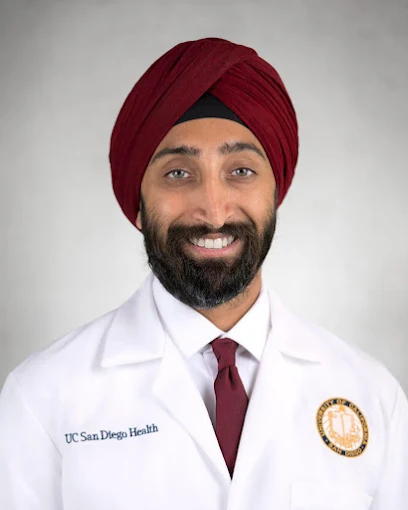
Dr. Harpreet Bhatia
Preventive cardiologist at UC San Diego and Associate Program Director of the Cardiovascular Diseases Fellowship. Trained at Emory University College of Medicine and Weill Cornell before joining UCSD, where he also earned a master's in clinical research.
The conversation.
Dr. Harpreet Bhatia is a preventive cardiologist at UC San Diego. His path to cardiology took him from Emory University, where he attended medical school, to Cornell, where he completed his internal medicine residency and chief residency, and eventually to San Diego for his cardiology fellowship. He also earned a master's degree in clinical research during his time at UC San Diego and later stayed on as a faculty member.
Today, his work is split between several different areas. He sees patients, conducts research, teaches medical students and cardiology fellows, and works on the broader question of how we can prevent cardiovascular disease before it becomes a serious problem.
I spoke with Dr. Bhatia about his journey, what makes someone a great physician, the future of preventive cardiology, and what students like me should actually be doing if we're interested in medicine.
What stayed with me.
Don't Get Overwhelmed by the Length of the Journey
One thing Dr. Bhatia said that stuck with me was that medicine is a long road, but you don't have to think about the entire road at once.
It's easy as a student to hear that becoming a doctor can take more than a decade and immediately start thinking about everything that's ahead — college, medical school, residency, fellowship, and eventually practicing independently.
Dr. Bhatia's advice was to take it one step at a time. If you're in medical school, focus on medical school. When you get to residency, focus on residency.
He also pointed out something that I hadn't really thought about before: once you're in residency, you're not simply a student anymore. You're still learning, but you're also doing a real job and taking care of patients. That changes the experience of training and makes each stage of the journey different.
Knowing the Science Isn't Enough
When I asked Dr. Bhatia what separates an exceptional physician from someone who simply gets through medical training, I expected him to talk mostly about academics.
Instead, he talked about the human side of medicine.
Medical knowledge is obviously important, but being a good doctor also means knowing how to talk to people, listen to them, understand what they care about, and empathize with them.
That stood out to me because preventive cardiology seems to depend on those skills. Dr. Bhatia isn't just treating a disease that a patient already has. A lot of his work involves talking with patients about their risk, understanding their goals and preferences, and figuring out how to help them reduce their risk of cardiovascular disease.
He also mentioned some qualities that aren't necessarily taught in a textbook: being hardworking, reliable, consistent, and professional.
His point was that you can have one or two of these qualities, but putting everything together is what makes a complete physician.
Preventive Cardiology Could Change Dramatically in the Next Decade
Dr. Bhatia is particularly excited about where preventive cardiology is going.
There are already more options than ever for preventing cardiovascular disease, including new cholesterol and blood pressure treatments. Researchers are also exploring things like gene editing, imaging, and genetic risk scores to better understand who is at risk.
But one of the most interesting parts of our conversation was his perspective on AI.
Dr. Bhatia doesn't see AI as something that should replace physicians. Instead, he sees it as another tool that could help doctors catch things they might otherwise miss.
For example, a busy physician might have a patient with multiple health concerns and not immediately notice that their blood pressure or cholesterol treatment could be optimized. An AI tool could potentially flag that information and help the physician make sure the patient is receiving the care recommended by current guidelines.
And eventually, he thinks AI could play a larger role in predicting who is most likely to develop cardiovascular disease and who might benefit from more aggressive prevention.
That idea gets at something important about preventive medicine: sometimes the challenge isn't figuring out what treatment exists. It's making sure the right patient actually gets it.
You Don't Need to Have Medicine Figured Out in High School
I especially appreciated Dr. Bhatia's answer when I asked what advice he would give to a high school student interested in becoming a doctor.
He didn't tell me to spend every summer trying to build the perfect medical résumé.
Instead, he said to focus on the fundamentals.
Pay attention in science classes and actually understand the basic biology behind what you're learning. But at the same time, don't overlook subjects like English and history. Dr. Bhatia described himself as somewhat of a liberal arts major and explained that being a good writer and critical thinker becomes incredibly valuable, particularly if you eventually become involved in research.
He also recommended getting some exposure to medicine through things like shadowing, but keeping an open mind. Medicine is incredibly broad, and spending a day with one type of doctor and not enjoying it doesn't mean medicine isn't right for you.
That was probably one of the most reassuring parts of the interview. You don't need to know your specialty — or even exactly what kind of doctor you want to become — while you're still in high school.
A Few Things I Took Away
After talking with Dr. Bhatia, I came away with a much broader view of what a career in medicine can look like. His work isn't just seeing patients in a clinic. It's also research, teaching, working with future doctors, and thinking about how technology could improve the way we prevent disease.
What probably stood out to me most was his description of the balance between the science and the human side of medicine. Understanding the science is obviously essential, but being able to communicate with a patient, understand what matters to them, and build a relationship is a completely different skill.
And for students who are still years away from medical school, his advice is pretty straightforward: learn the fundamentals, build good skills, explore medicine when you get the chance, and don't worry about having your entire future figured out right now.
What we talked about.
- 01From Emory to Manhattan to San Diego
- 02Taking the long road one step at a time
- 03What makes an exceptional physician
- 04The future of prevention and AI
- 05Advice for aspiring high schoolers
Watch the full conversation with Dr. Harpreet Bhatia.
The conversation, in full.
Could you introduce yourself and tell us a little bit about your journey into medicine?
My name is Harpreet Bhatia. I'm a preventive cardiologist at UC San Diego. And then, in terms of my journey in medicine, I went to medical school at Emory in Atlanta, and then did residency and chief residency in internal medicine at Cornell in Manhattan, and then came to San Diego, to UC San Diego, for a cardiology fellowship. I did a master's in clinical research during my time here, and then stayed on the faculty. Since then, I've been working in preventive cardiology, and both my clinical and research interests fall within that.
What advice would you give for someone starting med school?
So I kind of knew what I was getting into because of my dad being a doctor, but not everyone knows what they're getting into, and I saw a lot of that in medical school. The amount of work, you know, it requires, and dedication is something that, you know, just to be aware of, obviously, before going in. I think something else that I kind of had a sense of, but I learned more along the way, is that it's a long road, but you have to just take it one step at a time and kind of enjoy each step and not get bogged down in, you know, this long 12–15 year journey or whatever it is. But really, just focus on, you know, medical school. It's four years. You focus on that, then you go to the next step. The other is when you get into training, even though it's still training and you're not yet, you know, practicing independently as a doctor, you still are doing a job, and you still are learning, but also, you know, practicing medicine at the same time. So it's different when you're doing that. It's not like you're in school the whole time. So I think just having that long-term perspective is helpful.
Could you walk us through what a typical day looks like for you?
Yeah, so my week is pretty varied. So I don't really have a typical day because I'm in an academic medical center. I do a lot of different things. So typically, one day, Mondays are a full day of clinic; Tuesdays are a half day of clinic, where I'm seeing a mix of kind of overall cardiology patients, prevention patients, and then basically Tuesday, Wednesday, Thursday, Friday from afternoon on is a mix of doing research, doing meetings, working on administrative stuff. I work with our fellowship. I do medical school education, so kind of a mix of a lot of different things. So every day is different, which is part of what I like about it, because nothing is ever the same thing over and over again.
You said you were involved with the fellowship and the medical school, so someone like yourself who trains future doctors and cardiologists, what would you say separates a student who becomes an exceptional physician from those who simply get through medical training?
I think, I mean, it's a lot of things, and, you know, I think obviously there's medical knowledge being an important foundation for everything, but you'll see as you go through from medical school to residency, knowledge is a part of it, but it's not everything. And a lot of it is sort of the human side and art of medicine and knowing how to talk to patients, how to interact with people, how to empathize. A lot of what we do in preventive cardiology is really talking to people because a lot of times it's about trying to understand what their goals and preferences are, how we can align with that, and how we can help to reduce cardiovascular risk. So a lot of it is kind of the human interaction and the relationship with patients. So I think that's, you know, really important, and then, you know, the other obvious things like being hardworking. It's really important to be reliable, to be consistent, to be professional. So those kind of things, you know, definitely stand out. There's, you know, you'll see people might have like one piece or the other, but putting it all together, I think makes, you know, a complete physician.
Where would you see cardiology heading in the next decade, especially with AI, digital health, and preventive care?
So I think I'm biased, but I think prevention is the area of the biggest growth or the greatest growth in the next several years in cardiology, and part of that is driven by new therapies. So we have therapies for things that we never had before. There's kind of rapid progression of new cholesterol medications, treatments for blood pressure. There's research into, you know, one-time gene editing for lipid disorders or for high blood pressure or other more rare things. So we're seeing this like explosion of therapies and opportunities, options, while we're also further understanding risk and how we can understand an individual's risk, and use things like imaging, and now there are new things called genetic risk scores, which help to give us information as well. So a lot is going on within preventive cardiology. So I think that's probably the area where there's gonna be the greatest growth. AI is certainly going to play a role in medicine in the future. I think there's no question. I'm certainly not an expert in all of AI, but my feeling is that a lot of good is to be gained by AI being a tool and helping us improve, you know, clinical care, potentially doing things more efficiently. And one of the things we deal with in prevention is that we have guidelines on how to prevent cardiovascular disease, and a lot of cardiovascular disease is preventable. But we don't do a good job of basic things like treating people's blood pressure and getting their cholesterol to their goals and things like that, and I think that's something where AI can help sort of catch those things that we miss, especially when you're in a busy clinic visit and dealing with a bunch of other things. You know, an AI tool can really help point out to you how to optimize an individual's care, and then I think future steps will be that AI is probably going to have a role in risk prediction, figuring out who is more likely to develop disease and who needs more aggressive preventive therapies. So that's just some of it, but I think there's a lot that will happen in the future.
Is there any sort of reason that you chose to go into prevention, and how do you hope that this field changes with AI and with the cardiologists that you're training right now?
So, I got interested in prevention based on my experience in residency. So in residency, you know, you typically have a primary care type clinic that you're taking care of patients, and the patients I enjoyed taking care of the most were the ones who didn't necessarily have disease yet, but were interested in how to prevent cardiovascular disease in the future, and I found that really interesting and rewarding to kind of talk to someone about their risk factors, how to prevent disease in the future. And the other thing part of it is just that, you know, there's such a great burden of cardiovascular disease in the world, the leading cause of death in the entire world. So prevention is so important. The first presentation of cardiovascular disease can be death, so I always saw that there's such an important need to try to figure out who those people are who are at risk earlier on and how to prevent it. And so that's kind of what got me interested in the area and the field. And then, yeah, in terms of where I hope things go is in terms of things like AI and other tools. As I said, we know that most cardiovascular disease is preventable, but we don't always get the right therapies to the right patients. And hoping that AI helps us to close that gap in care, and in that we have. We have the medications; we have treatments, but we don't always get them to patients. And so, implementing and helping us remember, you know, this is a patient who should be on this kind of thing or whatever based on the guidelines, I think could make a big difference.
Lifestyle-wise, what are some big misconceptions people might have about preventing cardiovascular disease, and what do you wish some people would understand more about it?
So, good question. So, I think to start with, this part is not a misconception, but diet and exercise are very important and, you know, important predictors of future risk. And so, always try to talk about a healthy diet and healthy exercise. I think one of the misconceptions is that I treat a lot of people for high cholesterol, and one of the perceptions is that, oh, I can just eat healthier, and my cholesterol will improve, and I don't have to take medication. Oftentimes when we are identifying someone who we think needs medication, it's because they're at elevated risk, and our targets for lowering cholesterol are usually pretty aggressive. And get more aggressive the more risk you have. And the change that occurs with lifestyle changes in terms of diet and exercise on your cholesterol, LDL cholesterol, which is quote-unquote bad cholesterol, is usually pretty small unless, you know, you're at the extremes with a really, you know, bad diet full of fast food or something all the time. But otherwise, it's not going to make a huge difference. Same with weight loss, and so I think there's a perception that those things alone are going to be enough to get your cholesterol down. But I tell people a lot of times, most of your cholesterol circulating is determined by your genetics, and it's usually multiple different genes, but determined by genetics. And so, diet and exercise are definitely important, and we should be doing that. And that lowers overall risk, but it won't always lower the cholesterol as much as we want. It can make a bigger impact sometimes on things like blood pressure and things like that, but in terms of the cholesterol, usually we know that getting to really aggressive targets, really aggressive lowering, reduces risk, and so often that needs medication, and that's not necessarily a failure of lifestyle or anything like that. It's just that we understand so much more about cardiovascular risk. It's the number one cause of disease in the world or death in the world, no more than all other cancers combined. So why shouldn't we be aggressive about trying to prevent it with medications earlier?
What advice would you give to a high school student who is interested in pursuing medicine?
Yeah, good question. I think it's, you know, in high school you're just trying to get through high school, thinking and learning the basics, but really you're thinking about college and all that. So I wouldn't worry too much about it. But what I would say broadly is, you know, the fundamentals are really important, and I think some of the best doctors I've seen are people who understand the really basic fundamental science and biology of things really well. And so pay attention, you know, in your science classes, kind of learn all that. But there's also a lot of value, and I was sort of a liberal arts major, where there's a lot of value to English and history and all the other classes, because especially if you get interested in like research or something like that in the future, being a good writer is really important, and being a critical thinker is really important. So I would say just try to do well in high school and kind of learn the skills, and particularly, you know, pay attention in science. And then obviously, if you think you're going towards medicine, you know, that'll inform your choice of college potentially in places that have, you know, good pre-med type programs, and then I think, you know, it never hurts to get some exposure to medicine, you know, do some shadowing or something like that. Medicine's incredibly diverse, though, and so you may spend one day with a certain kind of doctor and not necessarily like it, or something like that. But medicine is very broad, and there are a lot of different ways to practice medicine, and there are a lot of different specialties and things. So just keep an open mind about that. And then, as you get into college, you probably want to get some experience working with doctors, seeing what it's like, potentially doing some research to help you know as you think about applying for medical school.